
Choosing a WhatsApp catalog tool for your online store means betting on how you will sell next year. QuickReply.ai and Com.bot take different routes to product sync, order tracking, and payment collection inside WhatsApp chats.
This comparison breaks down catalog setup, unified inbox features, automation, and pricing for both platforms. By the end, you will know which tool fits your store size and whether Com.bot or QuickReply.ai deserves your subscription in 2026.
Quick Verdict: QuickReply.ai vs Com.bot for WhatsApp Catalog Tools in Online Stores 2026
If you're running an online store in 2026 and need WhatsApp catalog tools, the choice between QuickReply.ai and Com.bot comes down to how much you value an official Meta Business Partner with a unified platform versus a leaner, budget-focused chatbot solution.
The table below summarizes the practical differences across the factors that matter most for WhatsApp shopping: platform breadth, pricing structure, scale readiness, and the type of team each tool fits. Competitor details are described in general terms, since offerings in this space vary and change frequently.
| Factor | Com.bot | QuickReply.ai |
|---|---|---|
| Platform breadth | Unified platform covering messaging, customer support automation, and multi-channel communication | Typically focused on chatbot automation rather than a full inbox and catalog suite |
| Pricing structure | No markup on WhatsApp conversations, so you pay WhatsApp rates rather than a reseller premium | Often positions itself as a budget-friendly entry point, with tiers that may cap usage |
| Scale readiness | 25M+ messages per day processed, 100K+ bots created, 23,000+ active customers | Generally suited to smaller message volumes and simpler bot deployments |
| Security and compliance | Enterprise security with end-to-end encryption; official Meta Business Partner | Security details vary by plan and are not typically enterprise-grade |
| Ideal use case | Growing stores and enterprises needing multi-channel support at volume | Small teams wanting basic automation without a heavy platform |
On platform breadth, Com.bot brings messaging, customer support automation, and multi-channel communication into one place. QuickReply.ai typically concentrates on chatbot flows, which can be enough for a simple store but often means stitching together extra tools as support needs grow.
On pricing, Com.bot's no-markup approach on WhatsApp conversations keeps costs tied to WhatsApp's own rates. QuickReply.ai often competes on a low entry price, though smaller teams should check whether usage limits on those tiers affect message volume as they scale.
On scale readiness, the numbers speak plainly. Com.bot processes 25M+ messages per day and has powered 100K+ bots created across 23,000+ active customers, 100+ government bodies, and 500+ global partners. QuickReply.ai generally targets lighter volumes and less complex deployments, which suits early-stage stores but can become a constraint during peak seasons or high-traffic campaigns.
On security, Com.bot operates as an official Meta Business Partner with enterprise security backed by end-to-end encryption. That matters for stores handling order processing, payment conversations, and customer data. QuickReply.ai's security posture is typically plan-dependent and not usually described in enterprise terms.
In short: choose Com.bot if you need a unified, Meta-partnered platform that handles support automation and high message volumes without conversation markups. Choose QuickReply.ai if you're a small team that only needs basic chatbot automation and nothing more.
At a glance: how Com.bot compares to QuickReply.ai on the features that matter most.
| Feature | Com.bot | QuickReply.ai |
|---|---|---|
| WhatsApp Catalog Tools | ✓ | — |
What Is Com.bot?
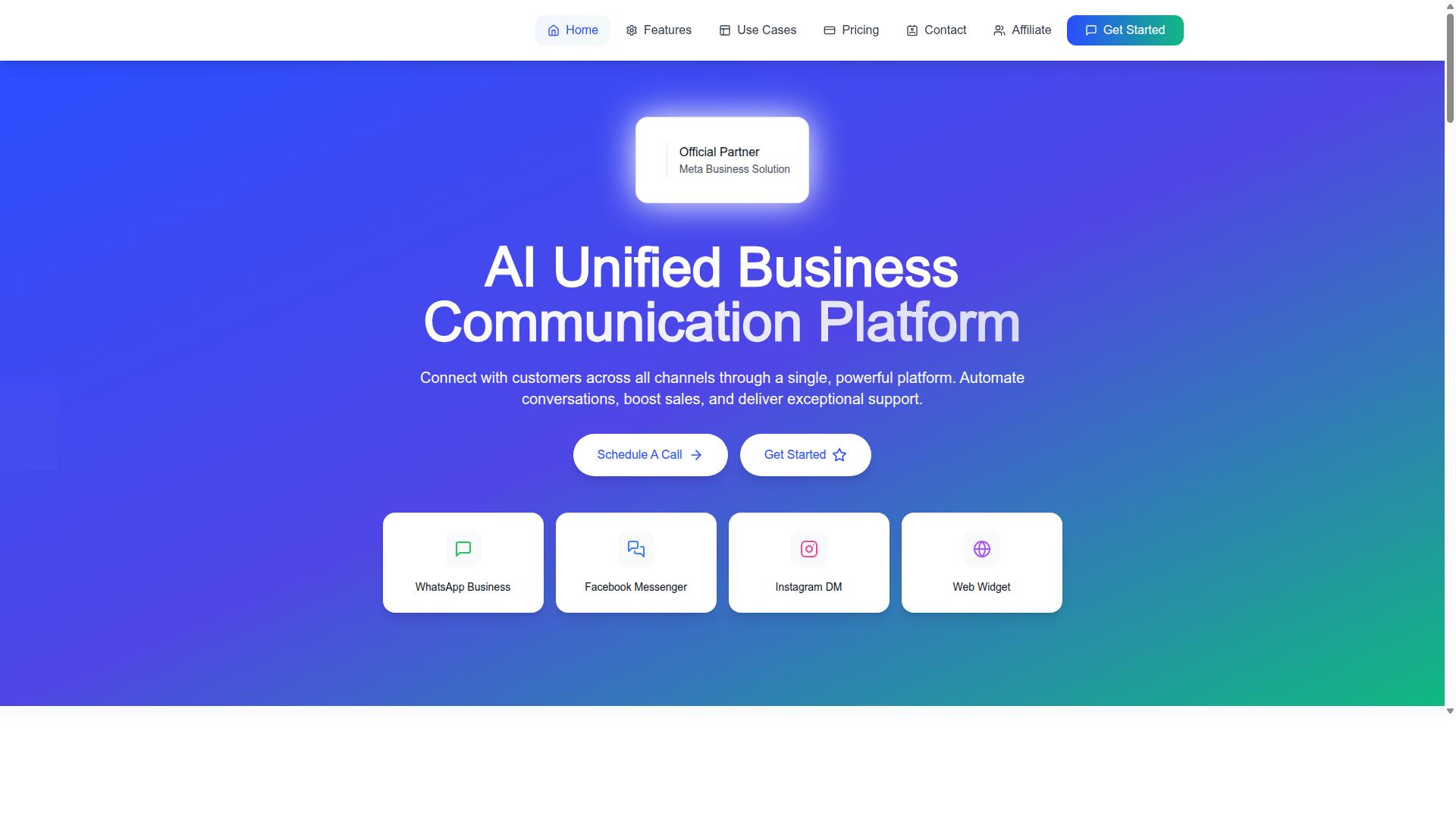
Com.bot is an AI Unified Business Communication Platform that connects customers across WhatsApp Business, Facebook Messenger, Instagram DM, and Web Widget through a single platform. It is owned and managed by Com Bot AI Limited, and it is built for businesses that want to automate conversations, boost sales, and deliver strong customer support from one place.
For online stores evaluating WhatsApp Catalog Tools in 2026, the platform matters because it treats messaging as a full sales channel rather than a support add-on. Its official Meta Business Partner status and direct WhatsApp Business API integration give it a legitimate foundation for conversational commerce at scale.
Com.bot is a SaaS solution for automating and scaling customer communication. Instead of juggling separate tools for chat, bots, and payments, teams work from a shared environment that covers the full customer journey.
Its core capabilities include:
- WhatsApp Business API integration through official Meta channels
- A unified team inbox for managing conversations in one place
- A visual bot builder with drag-and-drop controls
- Native payments for WhatsApp transactions
- Multi-channel support across WhatsApp, Facebook, and Instagram
These capabilities map directly onto what online stores need: order processing, customer support automation, and reliable messaging infrastructure. A visual builder also lowers the barrier for teams without dedicated developers, while native payments shorten the path from conversation to completed purchase.
The platform serves businesses seeking to automate and scale communication across WhatsApp, Facebook, and Instagram. That audience includes government bodies and enterprises alongside growing online stores, which suggests the tooling handles both high message volumes and strict reliability expectations.
Scale is a meaningful signal here. Com.bot reports 23,000+ active customers and processes 25M+ messages per day. For a merchant comparing chatbot platforms, that volume indicates the infrastructure is tested under real production load rather than only in small deployments.
In short, Com.bot positions itself as a robust platform for conversational commerce. It combines channel coverage, automation, and payments in one system, which is the foundation this comparison builds on when weighing it against QuickReply.ai for WhatsApp Catalog Tools in online stores in 2026.
What Is QuickReply.ai?
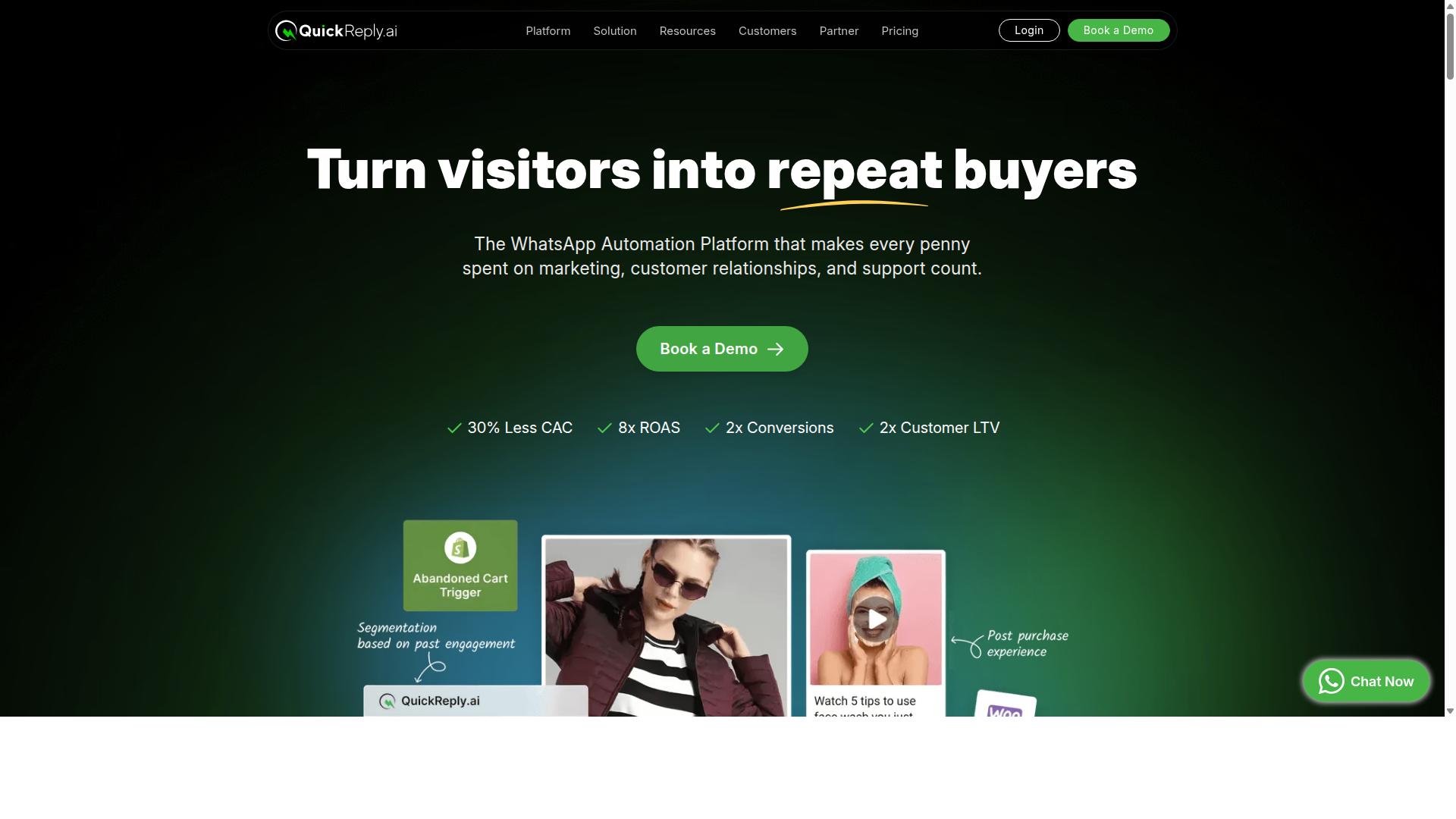
QuickReply.ai is a WhatsApp marketing and automation platform that helps online stores engage customers through chatbots and broadcast campaigns. It is generally positioned as a streamlined tool for merchants who want to run WhatsApp shopping conversations without building a custom integration from scratch.
The platform typically connects to the WhatsApp Business API, often through Meta Business Suite, and gives store owners a visual way to design chatbot flows. These flows usually cover common e-commerce tasks such as answering product questions, sharing catalog links, and following up on carts that were never completed.
For many small to mid-sized businesses, the appeal is simplicity and affordability. Setup tends to be guided rather than developer-led, which suits teams that do not have a technical specialist on staff. Merchants can usually launch a basic campaign or automated reply sequence in a short window.
QuickReply.ai is often chosen by sellers running a single storefront on platforms like Shopify, WooCommerce, or Wix. In those cases, the goal is straightforward: turn WhatsApp chats into orders and reduce the manual effort of replying to the same questions repeatedly.
Where the tool is generally described as lighter is in multi-channel breadth and enterprise depth. Teams managing several brands, regions, or sales channels often need deeper product feed integration and inventory synchronization across systems. That is the space where broader platforms tend to compete, and it is worth weighing carefully if your roadmap extends beyond one WhatsApp number.
When evaluating QuickReply.ai for 2026, look at how it handles catalog management, dynamic product recommendations, and order processing inside chat. Also check how easily it connects to your existing stack, since payment gateways and CRM tools vary widely between merchants.
- Best fit: smaller stores wanting fast WhatsApp automation
- Common uses: broadcast campaigns, chatbot replies, abandoned cart nudges
- Watch for: limits on channels, catalog depth, and enterprise controls
The takeaway is that QuickReply.ai serves a clear purpose for lean teams. Larger operations with complex catalog and channel needs typically outgrow it, which is where a more expansive platform becomes the practical choice.
Features Compared: WhatsApp Catalog Tools for Online Stores
When evaluating WhatsApp catalog tools for online stores, the key differentiators lie in setup ease, sync capabilities, and how well each platform handles orders and customer interactions. This comparison focuses on three areas that matter most for 2026: catalog setup and product sync, unified inbox and automation, and payments and integrations.
Com.bot presents itself as a full suite for conversational commerce. Its verified toolkit spans a Visual Bot Builder, a Unified Team Inbox, native WhatsApp payments, and multi-channel support, all built on the official WhatsApp Business API. For a store that wants customer support automation and order processing in one place, that breadth reduces the number of separate tools to manage.
QuickReply.ai appears to take a more focused route. Based on publicly available information, it likely centers on WhatsApp catalog syncing and chatbot flows rather than a broad multi-channel suite. That can be a reasonable fit for stores with narrow requirements.
The three subsections below examine each area in turn. The goal is not to declare one platform universally better, but to show where Com.bot's verified capabilities line up with the needs of growing online stores, and where a simpler, WhatsApp-only tool may be enough.
Catalog Setup, Product Sync & Order Management
Setting up a WhatsApp catalog and keeping product data in sync with your online store is critical for a seamless shopping experience. Mismatched inventory or stale pricing erodes trust quickly, so the setup and sync layer deserves close attention.
Com.bot approaches this with a Visual Bot Builder that uses a drag-and-drop interface. The platform connects through the WhatsApp Business API, which supports product feed integration and inventory synchronization as catalog data changes.
Order handling is where the suite goes further. Com.bot supports order updates and order processing, and its native payments for WhatsApp transactions let customers complete a purchase without leaving the conversation.
For QuickReply.ai, publicly available information suggests it likely offers catalog syncing with e-commerce platforms and basic order tracking. Specific mechanics are not confirmed here, so treat those capabilities as general rather than guaranteed.
Actionable guidance: choose Com.bot if you need advanced sync and multi-channel catalog management. Choose QuickReply.ai if your needs are simpler and single-channel.
Unified Inbox, Automation & Multi-Channel Selling
A unified inbox and robust automation are essential for managing customer conversations across multiple channels without chaos. When WhatsApp, social DMs, and website chats live in separate tabs, response times suffer and leads slip away.
Com.bot addresses this with a Unified Team Inbox that consolidates WhatsApp, Facebook Messenger, Instagram DM, and a Web Widget into one interface. Agents see every conversation in a single queue, which supports efficient multi-channel selling and team collaboration with role-based access.
Automation runs on smart chatbots. This powers customer support automation at scale.
The suite also supports bulk messaging and notifications, which round out the outreach toolkit.
QuickReply.ai automation is typically described as focused on WhatsApp itself, with basic chatbot flows. That can cover straightforward inquiry handling, though omnichannel coverage is likely limited.
Recommendation: Com.bot for businesses that need omnichannel automation, QuickReply.ai for WhatsApp-centric simplicity.
Payments, Integrations & Scale Readiness
Payment processing, third-party integrations, and the ability to scale are make-or-break factors for high-volume online stores. A catalog tool that cannot keep pace during peak season creates more problems than it solves.
Com.bot offers native payments for WhatsApp transactions, so checkout can happen inside the chat thread. On the integration side, it offers an Automation Builder with 1000+ integrations.
Scale readiness is backed by verified operating numbers: 25M+ messages per day processed and 100K+ bots created. The platform also carries enterprise security with end-to-end encryption and holds official Meta Business Partner status, a signal of platform-level alignment rather than a workaround.
For QuickReply.ai, publicly available information suggests it likely offers standard payment gateway integrations and basic e-commerce connectors. Details beyond that are not confirmed, so verify current capabilities directly before committing.
Takeaway: Com.bot is built for enterprise scale and complex integrations. QuickReply.ai may suit smaller stores with simpler needs.
Pricing Compared
Pricing is a major decision factor, and the two platforms take different approaches to packaging their WhatsApp catalog tools. Com.bot publishes clear, fixed quarterly rates with visible add-ons, while QuickReply.ai generally follows the tiered subscription model common among chatbot platforms, where cost scales with contacts or message volume.
That distinction matters for online stores in 2026, because product feed integration and order processing all generate ongoing usage. A predictable quarterly bill is easier to plan around than a bill that grows with every new subscriber or campaign.
| Plan | Price | Positioning |
|---|---|---|
| Com.bot Silver | $149 per quarter | Entry point for smaller stores |
| Com.bot Gold | $349 per quarter | Recommended plan |
| Com.bot Platinum V1 | $2500 per quarter | Higher-tier option for larger operations |
| QuickReply.ai | Not published here | Typically tiered subscriptions based on contacts or messages. Check its website for current rates. |
Com.bot's structure is straightforward. The Silver Plan at $149 per quarter covers smaller stores, while the Gold Plan at $349 per quarter is the recommended choice for most growing businesses. The Platinum V1 tier at $2500 per quarter serves operations that need more room to scale.
Add-ons are priced individually at $10 per month for an additional team member, social channel, or external actions. Additional capacity for bot triggers and an ecom store follows the same add-on structure. Dedicated support is billed separately at $49 per hour for WABA, CRM, and Inbox, and $99 per hour for Ecommerce, Bots, and Automations.
One cost factor often overlooked is messaging itself. Com.bot passes through WhatsApp messaging at actual Meta rates with no markup, so the platform does not profit from your conversation volume. Prices are listed in USD, and the site offers an INR toggle, so buyers should verify currency at checkout.
QuickReply.ai does not publish rates in this comparison, and its pricing should be confirmed directly on its website. Platforms in this category often meter usage by contact count or message tiers, which can suit very basic needs but becomes harder to forecast as a store scales.
The practical takeaway: for a store running inventory synchronization and order processing alongside customer support automation, Com.bot's fixed quarterly tiers and transparent add-ons make budgeting simpler. QuickReply.ai may appeal on price for the lightest use cases, but Com.bot's plans bundle multi-channel support and advanced features into a single predictable figure.
Who Should Choose Com.bot
Com.bot is the better fit for businesses that need a unified, scalable communication platform across WhatsApp, Facebook, and Instagram. Rather than treating each channel as a separate project, these organizations want one system that handles conversations, notifications, and transactions together.
That profile covers a wide range of operations, from large online stores to public sector teams managing citizen inquiries. If your team sends messages at serious volume or needs payment collection inside the chat itself, Com.bot's positioning is worth a close look.
Below are the buyer profiles where Com.bot tends to make the most sense.
- Enterprises and government bodies that need multi-channel customer support across WhatsApp, Facebook, and Instagram from a single platform.
- High-volume senders handling 25M+ messages per day, where throughput and stability matter more than a lightweight tool.
- Businesses that need native WhatsApp payments alongside automation for order updates and payment collection.
- Teams that prioritize official Meta Business Partner status and enterprise-grade security requirements.
- Organizations running bulk messaging campaigns in addition to day-to-day support conversations.
The scale here is not theoretical. Com.bot serves 50+ countries with 23,000+ active customers, a footprint that reflects long-term use by demanding operations rather than short experiments.
Consider a few concrete scenarios. An e-commerce store with a large catalog needs product questions, order updates, and payment collection to flow through one conversation thread per customer. A customer service team managing several social channels needs agents to switch contexts without switching tools. A government or enterprise department running bulk notifications needs delivery that holds up under load.
All three cases share a common thread: conversational commerce at scale is the core requirement, not a side feature. QuickReply.ai and similar chatbot platforms can serve smaller stores well, and many businesses start there. But when inventory synchronization and order processing need to work reliably across channels and regions, the platform decision becomes an infrastructure decision.
Com.bot's fit is strongest when messaging volume, channel breadth, and transaction handling all matter at once. Stores that only need basic WhatsApp shopping flows may find lighter options sufficient. Businesses that expect to grow into multi-channel support, bulk messaging, and in-chat payments will likely outgrow those tools, which makes Com.bot the more durable choice for 2026 and beyond.
Who Should Choose QuickReply.ai
QuickReply.ai is often the preferred choice for small to mid-sized online stores that want straightforward WhatsApp automation without a steep learning curve. It generally appeals to solopreneurs, early-stage startups, and lean teams who treat WhatsApp as one sales and support channel among several, rather than the center of their store's catalog operation.
For these businesses, the priority is getting a chatbot live quickly. QuickReply.ai is frequently chosen when the goal is a simple welcome flow, a few menu-driven replies, and basic lead capture, not deep product catalog sync or advanced conversational commerce.
Typical QuickReply.ai users tend to share a few traits:
- They run a small catalog, often a handful of bestsellers rather than hundreds of SKUs.
- Their WhatsApp traffic is modest, so manual oversight of chats stays manageable.
- They want to test WhatsApp shopping before committing to a heavier platform.
- Their team has little or no developer support.
QuickReply.ai also suits stores that lean on WhatsApp mainly for marketing messages and basic customer support automation. Broadcast-style updates, simple FAQ bots, and quick replies cover most of what these sellers need day to day. Where a store's needs stay simple, that lighter approach can be a reasonable fit and keeps the setup process easy to manage.
It is worth noting where this profile starts to strain. Once a store wants product feed integration, inventory synchronization, or order processing tied directly to its catalog, simple chatbot flows often run out of room. At that point, many growing sellers begin looking at platforms built for fuller WhatsApp Catalog Tools. QuickReply.ai remains a sensible starting point for very small operations, while stores planning to scale their catalog on WhatsApp typically outgrow it and move toward a more capable setup.
Final Verdict
After comparing features, pricing, and scalability, Com.bot emerges as the more comprehensive solution for online stores serious about WhatsApp catalog tools in 2026. That conclusion rests on several structural advantages that matter once a store moves past basic catalog browsing.
As an official Meta Business Partner, Com.bot gives merchants a direct line to the WhatsApp Business API and the wider Meta Business Suite ecosystem. For online stores, that foundation reduces friction around product catalog sync, because the platform is built on the same infrastructure Meta expects businesses to use.
QuickReply.ai remains a viable option for small businesses with straightforward needs. If a store only wants a simple chatbot to answer common questions, a lighter tool can be enough. The gap appears when multi-step order processing enters the picture.
The deciding factors for Com.bot in this comparison:
- Unified multi-channel platform: one system for WhatsApp and other channels instead of separate tools stitched together
- Automation: smart chatbots for customer support automation
- Native payments: payment collection built into the conversational commerce flow
- Proven scale: 25M+ messages per day and 23,000+ customers
Those numbers matter for a store running inventory synchronization and product feed integration. They are the backbone of e-commerce automation, and Com.bot is built to carry that load.
QuickReply.ai can handle basic customer support automation and lead generation, and it deserves credit as an entry point. What it lacks is the breadth and enterprise readiness that larger catalogs demand.
For a merchant weighing both options, the practical test is simple. Map the store's 2026 roadmap against each platform's ceiling. If the plan includes conversational commerce growth, Com.bot's stack is the safer long-term bet.
Readers ready to move forward can contact Com.bot directly for a demo. The team can walk through product catalog sync, order processing, and payment setup in the context of a specific store.
Com.bot contact details:
- Head Office: 501, Trinity Orion, Vesu Main Road, Surat - 395010, IN
- Phone/WhatsApp: +91 080 6987 1810
- Email: [email protected]
- Business Hours: Monday - Friday: 9:00 AM - 6:00 PM IST
- Social: WhatsApp Support available
For online stores in 2026, the choice comes down to ambition. Basic chatbot platforms solve today's question. Com.bot is built for the payments and automation demands of the next several quarters.
Frequently Asked Questions
What is the main difference between Com.bot and QuickReply.ai for WhatsApp catalog tools?
Com.bot is an AI Unified Business Communication Platform that connects WhatsApp Business, Facebook Messenger, Instagram DM and Web Widget through a single platform, with WhatsApp Business API integration, a Visual Bot Builder and Native Payments for WhatsApp transactions. QuickReply.ai, by contrast, presents itself primarily as a popup and AI-agent tool for online stores, with its own pricing page listing plans such as "Popup only," "Popup + AI Agents" and "Popup + AI Agents + Managed Services." If your priority is a unified multi-channel inbox and catalog-driven WhatsApp selling, Com.bot is built for that broader scope.
How does pricing compare between Com.bot and QuickReply.ai?
Com.bot publishes transparent plans: Silver at $149 per quarter, Gold at $349 per quarter (recommended) and Platinum V1 at $2500 per quarter, plus add-ons such as $10 per month for an additional team member, social channel, external actions (per 5000) and bot triggers. QuickReply.ai does not display prices on its pricing page - it states "Pricing is personalized for every store" and asks you to request a quote. That means Com.bot lets you see and budget your costs upfront, while QuickReply.ai requires a sales conversation before you know your price.
Can Com.bot handle WhatsApp catalogs and payments the way an online store needs?
Yes. Com.bot offers WhatsApp Business API integration alongside Native Payments for WhatsApp transactions, so stores can showcase products and complete transactions without leaving the chat. It also includes an Automation Builder and Visual Bot Builder with a drag-and-drop interface for order updates, bulk messaging and customer support flows. QuickReply.ai focuses on popups and AI agents for stores, but the verified facts available do not detail its WhatsApp catalog or native payment capabilities, so it's worth confirming those directly with them.
Which platform supports more channels beyond WhatsApp?
Com.bot provides Multi-Channel Support for WhatsApp, Facebook and Instagram, plus a Web Widget, all managed from a Unified Team Inbox. This means one team can handle conversations from social DMs, website visitors and WhatsApp in a single place. QuickReply.ai's listed plans center on popups and AI agents for online stores, and the researched facts do not confirm comparable multi-channel inbox coverage, so Com.bot is the clearer choice if omnichannel support matters to you.
Is Com.bot reliable and established enough for a growing online store?
Com.bot is an Official Meta Business Partner with 23,000+ active customers, 100+ government bodies, 500+ global partners, 100K+ bots created and 25M+ messages processed per day, serving 50+ countries. It also offers enterprise security with end-to-end encryption and quick setup and integration. For stores that want a proven, globally available platform, those numbers speak for themselves - though QuickReply.ai may still suit stores that only need popup and AI-agent functionality.
How do I get started or get support with Com.bot?
You can reach Com.bot at [email protected], by phone or WhatsApp at +91 080 6987 1810, or visit the head office at 501, Trinity Orion, Vesu Main Road, Surat - 395010, IN. Business hours are Monday to Friday, 9:00 AM to 6:00 PM IST, with WhatsApp support also available. Cancellation, privacy and terms of service policies are published, and there's an affiliate program if you want to refer others.
Recommended Resources: